Overview
Collimation aligns the two optical paths closely enough that the brain can merge both images comfortably into one coherent view. This guide focuses on the practical consequences at the eyepiece, because specifications only become useful when they explain image brightness, comfort, stability or target choice.
What collimation means
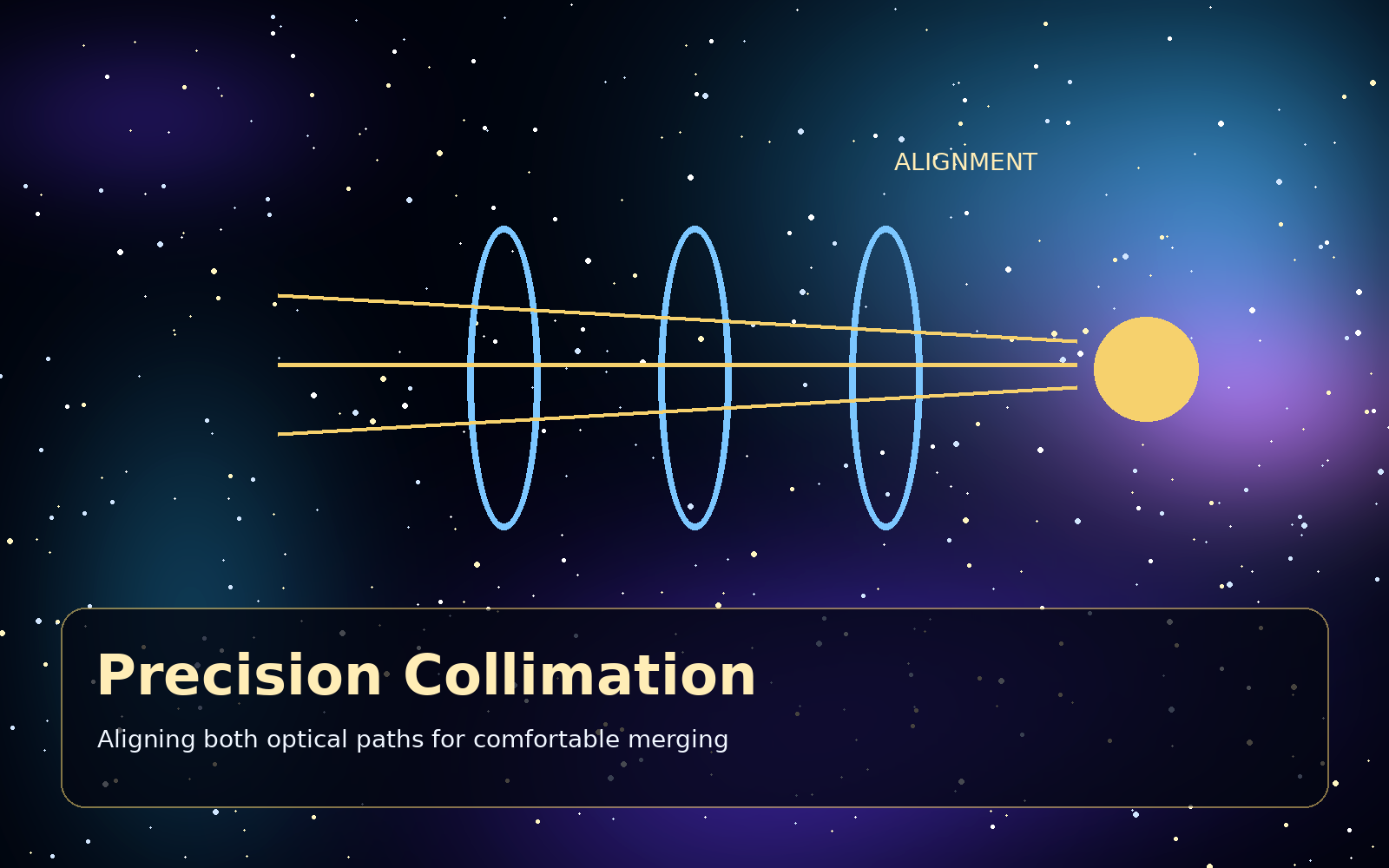
Collimation is the alignment of the two optical axes so corresponding details land in positions the brain can merge comfortably.
Why high power is demanding
Small errors that are unnoticed at low power become obvious as magnification rises. A system intended for planets needs more precise and stable alignment than a low-power sweeping instrument.
Mechanical stability
Collimation that changes with altitude is a structural problem, not merely an adjustment problem. Rigid tube supports and repeatable mechanical interfaces matter enormously.
A practical way to evaluate it
Use the instrument under the conditions that matter to you. Check whether both eyes merge the image without effort, whether the mount settles quickly after focusing and whether the field remains comfortable during a ten- or fifteen-minute observation. These real-world checks reveal problems that specification sheets cannot.
Common mistakes to avoid
Avoid treating one specification as the entire story. More aperture, more magnification or a wider apparent field can be attractive, but each choice affects weight, exit pupil, edge correction, collimation tolerance or ergonomics. A balanced system is usually more enjoyable than one optimized around a single number.
Final perspective
A binoscope is successful when the optical, mechanical and human factors work together. The best setup is not necessarily the largest or most expensive one. It is the system that stays aligned, moves smoothly, fits the observer comfortably and makes it easy to spend time looking at the sky.
When comparing equipment, keep the observing environment in mind. A system that performs beautifully from a permanent backyard setup may be inconvenient for someone who must carry every component down stairs or load it into a small car. Portability, setup time and viewing posture influence how often the instrument is actually used.
It also helps to separate optical limits from atmospheric limits. Seeing conditions can make high magnification look soft even when the optics are excellent, while light pollution can hide faint deep-sky structure that would be obvious from a darker site. Evaluate an instrument across several nights before drawing conclusions from a single session.
For two-eye systems, comfort is a performance metric. If eyepiece spacing, eye relief or image merging forces the observer to strain, the theoretical optical quality is not being fully used. Small ergonomic adjustments can produce a larger improvement than another step in aperture or magnification.
Frequently Asked Questions
Is binoscope collimation guide important for beginners?
It can be, but beginners do not need to master every detail immediately. Start with the concept that affects comfort or image quality most directly, then add complexity as your observing experience grows.
Do larger binocular telescopes always give a better view?
No. Larger aperture gathers more light, but it also increases weight, mounting demands and cost. A smaller instrument that is well mounted and easy to use can be the better choice.
Why is setup quality so important in two-eye observing?
Both optical paths must work together. Poor alignment, unstable support or mismatched focus can create eye strain even when each tube is individually sharp.